
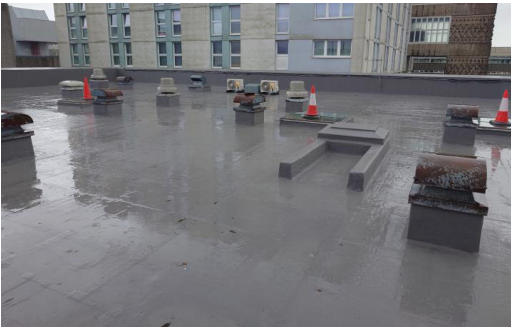
Most roof leaks are found indoors first: a stained ceiling tile, a damp patch on a ward. By then, water may have tracked through the build-up. A commercial roof maintenance checklist catches faults while they are small, and proves you looked.
BS 6229 guidance and manufacturer guides set the baseline: inspect a flat roof at least twice a year. Autumn clears debris so outlets drain. Spring finds weather damage. Add a check after extreme weather, vandalism, or works on or next to the roof.
The seven areas below follow an inspector’s route across single ply, felt, liquid applied, asphalt, metal and fibre cement roofs. A competent person checks from safe access, in line with the Work at Height Regulations.
1. Start With Safe Access, Rooflights and Fragile Surfaces
According to HSE, falls through fragile surfaces, particularly fibre-cement roofs and rooflights, account for 22% of all fall from height fatal injuries in construction. HSG33 is clear that this is not just a contractor problem: building maintenance staff fall from and through roofs too, often on quick jobs like clearing a gutter or checking a vent.
HSE’s starting point is blunt: “All roofs, once fixed, should be treated as fragile until a competent person has confirmed that they are non-fragile.”
Before anyone goes up:
- [ ] A fragile roof register or marked plan exists, with fragile areas signed at every access point
- [ ] Rooflights are free of cracks and UV embrittlement, with mesh or covers intact
- [ ] Profiled fibre cement is treated as fragile, and the asbestos register checked under your duty to manage (Control of Asbestos Regulations 2012)
- [ ] Corroded metal sheets and wired glass are identified and protected
- [ ] Edge protection, guard rails, walkways and stagings are intact
- [ ] Fall arrest and restraint anchors are present and in test date
Where work at height cannot be avoided, the Work at Height Regulations 2005 require a risk assessment, a safe system of work and competent people. You keep a duty as the client, even after appointing a contractor.
If no one can tell you which parts of your roof are fragile, start there before booking anything else.
2. Clear and Test Outlets, Gutters and Downpipes
A flat roof relies entirely on its outlets and gutters, and a handful of leaves can restrict an outlet enough for a heavy downpour to outpace it. Clearing drainage is the highest-value task on this commercial roof maintenance checklist and the core of the BS 6229 autumn inspection.
- [ ] Outlets, leaf guards, gratings and chutes are clear and properly seated
- [ ] Box, valley and eaves gutters are free of silt, moss and vegetation, with no leaking joints
- [ ] Downpipes run freely, with no overflow staining on the walls below
- [ ] Ponding is photographed: any water still standing after rain has stopped
- [ ] Overflow and warning pipes, scuppers and siphonic outlets are unobstructed
- [ ] Gutter linings on profiled metal roofs are sound (leaks on these roofs often show in the gutter area)
Twice a year is the minimum. Some UK guidance suggests clearing outlets quarterly, and BS 6229 notes heavily wooded sites may need more frequent checks.
Persistent ponding is also a design question for your contractor. BS 6229:2025 sets a minimum completed fall of 1:80, and if water still ponds with clear outlets, the drainage design itself may need checking against BS EN 12056-3.
Of every check on this list, autumn drainage is the one never to skip.
3. Check the Membrane and Roof Surface for Your Roof Type
A blister on mastic asphalt, a lifted seam on single ply and a rusting cut edge on metal sheeting are all “membrane defects”, but they mean different things. Know your roof type first.
On every roof, check for:
- [ ] Splits, punctures, cracks and blisters
- [ ] Previous patch repairs that are lifting or failing
- [ ] Moss, vegetation, debris or foot-traffic damage
Then add your system’s checks:
- Single ply: seam and lap integrity, and punctures
- Built-up felt (RBM): splits, blistering, and loss of surface protection or chippings
- Liquid applied: coating wear, cracking at details, degraded sealant and pointing
- Mastic asphalt: cracks, splits and blisters
- Profiled metal: cut-edge corrosion on pre-coated sheets, and missing, uncapped or corroded fixings
- Fibre cement: cracks and surface deterioration, viewed from safe access only, after checking the asbestos register
- Green and blue roofs: follow the designer’s original inspection plan
A patch that keeps failing often means the symptom was fixed and the cause was not, and water may have saturated a wider area. See the signs a commercial roof needs repair.
Escalate if: you find widespread blistering, soft areas underfoot or a history of repeat repairs. That is the point to weigh repair against replacement.
4. Inspect Upstands, Flashings and Terminations
You can have a membrane in good condition and still let water in. The weak point is often where the roof turns up a wall, meets a parapet or wraps around a rooflight kerb, because those details move, weather and get stood on.
- [ ] Upstands at walls, plant bases and rooflight kerbs are fully bonded, not slumping or split, and at a sound height above the finished roof surface
- [ ] Lead and metal flashings are secure and not lifted by wind, with wedges and clips in place
- [ ] Termination bars and edge trims are fixed, with sealant intact
- [ ] Mastic sealant and mortar pointing are not cracked or perished
- [ ] Expansion joints are intact and not split
Compare the cost of waiting. A split upstand is a small repair. The same split left open for a winter can wet the insulation beneath a much larger area.
5. Check Penetrations and Rooftop Plant After Every Install
M&E, telecoms and solar contractors finish and leave. Too often, nobody checks the roof they walked across and drilled through. BS 6229 guidance lists works on or next to the roof, including equipment installation, as a trigger for an extra inspection.
- [ ] Pipe, duct and cable penetrations have sealed collars or sleeves, with no gaps
- [ ] Plant bases and supports are not sinking into or cutting the membrane
- [ ] Condensate and discharge from air conditioning units are not running onto or ponding on the roof
- [ ] Satellite dishes, safety barriers, fall arrest posts and other installations are securely and watertightly attached
- [ ] No debris has been left behind: screws, offcuts or metal swarf, which rusts on metal roofs
- [ ] Walkways or protection boards are in place on plant access routes
Build a roof sign-off into the permit to work for any trade going onto the roof.
If a contractor has been on your roof since the last inspection, book a check now rather than waiting for spring.
6. Edges, Parapets and the View From Inside
Part of this commercial roof maintenance checklist needs no work at height at all. BS 6229 guidance includes interior ceilings, external walls, eaves and soffits in its inspection scope, so your own team can cover them from the ground and from inside.
Perimeter:
- [ ] Copings and parapet caps are secure, with joints sealed
- [ ] Edge trims and eaves are fixed
- [ ] Render or brickwork below parapets shows no cracking, efflorescence or staining
- [ ] No signs of movement in walls, eaves or soffits
Inside:
- [ ] No stained or damp ceiling tiles, tidemarks or musty smells
- [ ] No condensation on the underside of the roof (not always a leak, but worth recording)
Photograph overlapping tidemarks: they suggest long-running ingress, exactly what a loss adjuster looks for.
Best for: a monthly site walk by your own team. It is not a substitute for the twice-yearly roof inspection.
7. Keep the Roof File: Schedule, Records and Guarantee Conditions
After a storm, insurers and manufacturers often ask: when was the roof last checked, and can you prove it?
Build your roof maintenance schedule by season:
- Autumn: full inspection, drainage cleared before winter
- Spring: full inspection for winter wind and frost damage
- After triggers: storms, vandalism, or works on or next to the roof
- Ongoing: item 6’s ground-level and internal checks
Log every visit:
- [ ] Date, inspector and company
- [ ] Areas inspected
- [ ] Dated photos of each defect
- [ ] Actions taken, with invoices
- [ ] Next due date
File it with the O&M manual and the asbestos and fragile roof registers.
Lack of maintenance and wear and tear are common storm-claim exclusions; adjusters cite blocked gutters and perished sealant. That commentary is mostly consumer and small-business focused, so check your commercial policy wording.
Guarantees often depend on maintenance too. Bauder, for example, asks for six-monthly maintenance in line with BS 6229 and warns failures from lack of maintenance may not be covered. Some also require an approved contractor, so check your guarantee document.
Treat the roof file as part of the roof. Without it, the twice-yearly inspection protects the building but not your claim. NSS teams are directly employed (no subcontracting) and can run inspections and keep records. Talk to our roofing team about a planned preventative roof maintenance programme.
FAQ
How often should a commercial flat roof be inspected in the UK?
At least twice a year, in spring and autumn, in line with BS 6229 guidance and manufacturer maintenance guides. Add an inspection after extreme weather, vandalism, or any works or equipment installation on or next to the roof. Check your guarantee for extra requirements.
Can our own maintenance staff clear the gutters?
Only if the task is risk assessed under the Work at Height Regulations 2005, the person is competent, and fragile surfaces are controlled. HSE’s roof work guidance warns that maintenance staff on short, routine jobs are among those who fall from and through roofs. Where possible, use ground-level methods or a specialist with safe access.
How much does a commercial roof inspection cost?
As an indication only, one UK roofer quoted around £250 to £500 for a basic inspection and minor maintenance visit, and £500 to several thousand pounds for planned maintenance on larger commercial roofs, with access equipment extra. Prices vary with roof size, access and roof type, so a survey is needed for a firm price.
Will my insurer refuse a storm claim on a poorly maintained roof?
It can. Lack of maintenance and wear and tear are common exclusions. Dated inspection reports, photos and invoices are your best evidence that the storm, not neglect, caused the damage. Commercial policy wording varies, so check yours.