
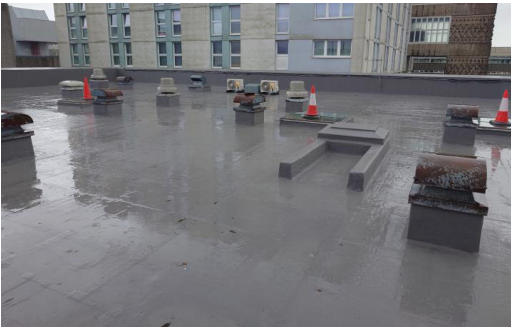
It is the third leak this winter, in the same bay, over the same racking. One contractor wants to patch it. Another has quoted for a full strip and replace. Your budget holder wants one number by Friday.
Most guidance on commercial roof repair vs replacement is written for American roofs, American costs and a simple two-way choice. UK commercial stock rarely works like that. There is a third route, commercial roof refurbishment (an overlay, a liquid-applied system, cut-edge treatment or overcladding), and the right answer depends on things a US guide never mentions: a moisture survey, Approved Document L, asbestos cement, your lease and HMRC.
Below, the three options are compared side by side, followed by six criteria in the order you should check them and a decision sequence you can defend.
Repair, Refurbish or Replace: The Three Options Compared
Which option does a tired UK flat roof most often need? Frequently, neither of the two in the title of this article.
Contractors use “repair”, “refurb”, “overlay” and “replacement” loosely, which makes quotes hard to compare. Pin the definitions down first.
Repair is localised work: a puncture, failed laps or seams, a split flashing, a leaking outlet, an area of storm damage. It restores function where the defect is. It does not normally reset the roof’s service life or its guarantee.
Refurbish (overlay) keeps the existing build-up where it is dry and sound and applies a new covering over it: single ply, reinforced bitumen membrane (RBM) or a liquid-applied system, with wet areas stripped out first. On profiled metal the equivalent is cut-edge treatment and recoating. On asbestos cement it is overcladding.
Strip and replace takes the roof back to the deck, renews insulation and waterproofing, and starts a new guarantee.
| Factor | Repair | Refurbish / overlay | Strip and replace |
|---|---|---|---|
| Typical scope | Isolated defects | Whole roof or zones, partial strip of wet areas | Full removal to deck |
| Viable when | Roof has life left; defect is local | Survey proves a dry, sound substrate | Widespread saturation, end of life or deck failure |
| Guarantee | Usually workmanship only | New system guarantee, depending on manufacturer and installer | New system guarantee, depending on manufacturer and installer |
| Building Regs / ADL | Generally not triggered | Building work (NFRC GN81); membrane renewal is renovation of a thermal element | Renovation of a thermal element |
| Disruption and waste | Minimal | No strip-off waste on dry areas; building usually stays operational | Highest: strip-off, waste and weather exposure |
The design code behind all three is BS 6229, the British Standard for flat roofs. Which column fits your roof depends on six criteria, starting with what is sitting under the membrane.
1. Moisture Survey Results: The Evidence That Should Decide It
A roof can look sound from the walkway and still hold water across a large part of its insulation. A visual walkover cannot support a six-figure capital decision. Measured moisture data can.
How the survey works
Three methods do most of the work:
- Thermographic (infrared) imaging, which shows where wet insulation is holding heat differently from dry areas.
- Nuclear moisture mapping, with readings taken across the roof on a grid.
- Core samples, cut through the build-up to confirm what the instruments show.
Bauder, a flat roof manufacturer, describes nuclear gauges reading to about 300mm deep across a 250mm diameter, typically on a 2m grid. The results are plotted on a roof drawing, with a histogram separating wet readings from dry.
How the results map to the three options
The survey drawing is effectively your decision. Wet zones are stripped and the insulation replaced. Dry zones can be overlaid, so remedial work is limited to the areas that need it. An isolated wet patch with dry surroundings points to repair. Saturation across most of the roof points to strip and replace.
Why it matters: a coating or overlay applied over trapped moisture tends to blister and split. You pay for a new surface and inherit the old problem.
You may see a US contractor rule of thumb that replacement becomes the stronger case once 25 to 30% of the roof area is wet. It is an unsourced heuristic, not a UK standard. Your own survey drawing is a far better guide, and the wet area it shows also feeds the Approved Document L test in criterion 3.
A thermal or drone survey is a useful first look on large or hard-to-access roofs, but it does not replace cores. If you are unsure whether you have reached this point, the signs your commercial roof needs repair are a good starting list.
Being quoted for an overlay or a full strip without a moisture survey drawing? Ask for one before you compare prices.
2. Age, Roof System and Repair History: How Much Life Is Left?
Each callout is cheap. The leak stops. Then the log grows by another line, the guarantee expired years ago, and nobody can say how much life the roof has left.
Indicative service lives by UK system
There is no single “20 years” answer. These commercial roof lifespan figures are indicative only:
- Liquid-applied: GreenSpec gives 10 to 20 years for modified bitumen, 20 to 30 for polyester-based and 10 to 25 for polyurethane-based systems, assessed under ETAG 005 durability categories of 5, 10 and 25 years.
- Single ply: lifetime-cost data from Building magazine (2002) put it at around 25 years. Sika-Trocal’s BBA-certified lifespan has since been extended from 30 to 35 years, but that is one manufacturer’s membrane, not a rule for all single ply.
- Reinforced bitumen membrane: around 20 to 25 years in the same 2002 dataset, depending on cap sheet.
- Mastic asphalt: about 50 years in that dataset.
Treat the 2002 figures as a prompt for your surveyor, not a budget.
Guarantees
A repair normally carries a workmanship guarantee only. An overlay or new system installed by an approved contractor can typically carry a long-term, manufacturer-issued, insurance-backed guarantee. Check the length, the issuer and whether it transfers before you compare quotes.
Your repair log is the real signal
Recurring leaks in the same zones, multiple patches, saturated insulation and a roof near its expected life all point towards refurbishment or replacement. Keep a dated defect and repair log from the twice-yearly inspections BS 6229 recommends; our commercial roof maintenance checklist sets out the routine. Insurers and landlords ask for that log too.
Repair suits a roof within its expected life with isolated defects. Skip it if the same bays keep failing on a roof near or past that point.
3. Approved Document L: When Re-Covering a Flat Roof Becomes Renovation
Replacing the waterproof membrane on a flat roof is not maintenance in the eyes of the Building Regulations. Approved Document L Volume 2 (2021 edition, incorporating 2023 amendments) lists it at paragraph 11.2(d) as renovating a thermal element.
That single classification can change your budget.
The 50% trigger
Under paragraph 11.3, if you renovate more than 50% of the surface of an individual thermal element, or more than 25% of the building’s external envelope (a major renovation), the whole element should be improved to the U-value in Table 4.2, column (b). For a flat roof, or a roof with integral insulation:
- Threshold value: 0.35 W/m²K
- Improved value: 0.18 W/m²K
The feasibility qualifier
Paragraph 4.8 allows a lesser standard where 0.18 W/m²K is not technically or functionally feasible, or would not achieve a simple payback of 15 years or less. In that case, upgrade to the best U-value that is feasible within a 15-year payback, generally no worse than 0.7 W/m²K. Condensation risk under Part C can also justify a lesser standard.
Overlays are not exempt
NFRC guidance note GN81 states that flat roof overlays constitute building work to be assessed against the Building Regulations. Plan for building control involvement on an overlay just as you would on a strip and replace. A small repair generally does not trigger it.
What it means for your decision
Extra insulation depth affects upstands, outlets, parapet heights and door thresholds, and it adds cost. It also improves the building’s energy performance, which belongs in the business case. Agree the approach with building control early rather than designing the scope around the threshold.
A 2026 edition of Approved Document L Volume 2 keeps the same renovation rules but does not take effect until 24 March 2027 (24 September 2027 for higher-risk building work). For work now, the 2021 edition applies. Our guide to Approved Document L for commercial roofing covers the detail.
If your preferred option re-covers more than half the roof, budget for insulation from day one.
4. Cost Over the Remaining Life, Not the Quote in Front of You
One calculation reframes the conversation with your budget holder: divide each option’s cost by the years of reliable life it buys.
Indicative UK figures, with a health warning
UK cost aggregator data puts commercial roof replacement cost at roughly £90 to £180+ per m² depending on system, with an insulation upgrade adding around £20 to £40 per m² and timber deck replacement £25 to £50 per m². These are crowd-sourced, indicative figures, and rates per m² generally fall on larger roofs. No reliable published figure exists for commercial overlays or repairs. A surveyed quotation is the only number worth taking to a budget meeting.
What a like-for-like comparison must include
Ask every contractor to price the same scope:
- Access and edge protection: scaffold, MEWPs and fragile-roof controls (see our guide to the Work at Height Regulations for facilities managers)
- Insulation required under Approved Document L (criterion 3)
- Deck repairs uncovered on strip-off
- Waste and disposal
- Business disruption and out-of-hours working
- Guarantee length and who issues it
Repair spend as a signal
US contractors quote rules of thumb, such as replacing once a repair exceeds 20 to 30% of replacement cost, or once annual repair spend approaches 10 to 15% of it. These are unsourced US heuristics, not UK guidance. A better test: total the last three to five years of spend from your own repair log and set it against the surveyed options.
The insurance angle
Insurers generally pay to reinstate what you had, not to upgrade it, so betterment tends to fall to the owner. Check your policy wording. Storm claims often turn on whether the storm or gradual wear caused the damage, and an up-to-date inspection log is the evidence that settles it.
An overlay usually costs more than a repair today but can buy a new guarantee period without strip-off. The repair is only cheaper while the roof has life left to protect.
5. Metal and Asbestos Cement Roofs: Treat, Overclad or Remove
The warehouse roof that leaks at every lap. The 1970s asbestos cement roof nobody wants to touch. Here the third option is not an overlay, and safety dominates.
Profiled metal
Cut-edge corrosion starts where the factory coating has been cut: sheet edges, laps and fixings. Coatings contractors commonly cite it as a leading cause of leaks on metal roofs. Treatment runs:
- Remove loose coating
- Clean and treat the rust
- Encapsulate edges and laps
- Apply a protective coating
It only works while sheets and fixings remain structurally sound. Badly perforated sheets need replacement or over-roofing. Rooflights are often fragile, so access planning applies even to a “simple” coating job.
Asbestos cement
The Control of Asbestos Regulations 2012 apply to any work on asbestos cement (AC) sheets. HSE’s survey guide, HSG264, requires a refurbishment and demolition survey before any refurbishment or demolition work. It is fully intrusive and covers the area where the work will take place.
Your options are to manage the roof in place, encapsulate it, overclad it or remove it:
- Overcladding avoids disturbing the material and the disposal cost, but the asbestos stays on your register and management plan.
- Removal of AC sheets on a small scale is non-licensed work under HSE task sheet A14, provided the sheets stay intact. If they break up and create significant dust, it becomes notifiable non-licensed work. A14 does not cover large-scale work or mechanical demolition, which needs a full risk assessment and plan of work, and an HSE-licensed contractor is needed where insulating board or lagging is also present. A full commercial roof strip will usually go beyond A14’s “small scale”.
Overcladding adds weight, so check the structure first; our guide to commercial roof structural load requirements explains what to ask for.
Whatever you choose, fragile-roof access is the headline risk. HSE puts falls through fragile surfaces, particularly fibre-cement roofs and rooflights, at 22% of all fall from height deaths in construction, and its guidance is to treat every fixed roof as fragile until a competent person confirms otherwise. AC becomes more fragile with age.
Start with the refurbishment survey and a fragile-roof access plan, not a coatings quote.
6. Lease, Tax and CDM: The Paperwork That Can Change the Answer
Two English courts, two roofs, two opposite answers on whether “repair” meant patching or renewal. The technical choice is only half the decision.
Lease and dilapidations
In Sunlife Europe Properties v Tiger Aspect Holdings, a lead mansard roof had deteriorated so far that total replacement was justified. In Carmel Southend v Strachan & Henshaw, an industrial roof should have been patch repaired by replacing a small number of sheets. Where there are two reasonable ways to perform a repairing covenant, the tenant generally gets to choose. The outcome turns on lease wording and expert surveyor evidence, so check the repairing covenant and service charge provisions with your surveyor or solicitor before you instruct.
Tax treatment
HMRC’s Business Income Manual (BIM46915) treats restoring an asset to what it was as a repair, generally a revenue deduction. Altering or improving it is capital. HMRC’s own example treats a new roof that simply returns the roof to its original condition as a repair, and modern equivalent materials do not by themselves make the work an improvement. Landlords look to the Property Income Manual instead. The treatment is fact specific, so check with your accountant before the budget line is set.
CDM 2015
The Construction (Design and Management) Regulations 2015 apply to commercial roofing work, and as a commercial client you carry client duties on every project, including providing pre-construction information. Where more than one contractor will work on the project, you must appoint a principal designer and a principal contractor in writing. You must also notify HSE on an F10 if the work is likely to last longer than 30 working days and have more than 20 workers on site simultaneously at any point, or exceed 500 person days.
Appointing a contractor does not hand over your duties. Under section 4 of the Health and Safety at Work etc. Act 1974, you keep responsibility for the premises. Our guide on how to vet a roofing contractor covers competence, CDM and insurance checks.
Before you instruct, confirm the lease clause, the likely tax treatment and who holds each CDM role.
The Bottom Line: Repair, Refurbish or Replace?
Repair while the roof has life left and the problem is local. Refurbish or overlay where the survey shows a mostly dry, sound build-up. Strip and replace where saturation is widespread, the system is at the end of its life, or the deck has failed.
The commercial roof repair vs replacement decision is far easier to defend to finance, a landlord or an insurer if you follow the same sequence every time:
- Commission a survey: thermal imaging and/or moisture mapping, verified by cores.
- Map wet versus dry insulation on a roof drawing.
- Check the area to be re-covered against the Approved Document L 50% rule.
- Check for asbestos cement and other asbestos-containing materials with a refurbishment and demolition survey.
- Compare repair, overlay and replacement over the remaining life, not the headline quote.
- Check your lease, insurer and likely tax treatment.
- Set up CDM roles before work starts.
On most roofs the first two steps make the answer obvious. The rest makes sure it survives scrutiny.
NSS carries out roof surveys, repairs and refurbishment nationwide with directly employed teams, not subcontractors. If you want a second view on a quote, or a survey that gives you the evidence first, speak to our roofing team.
FAQ
How long does a commercial flat roof last in the UK?
It depends on the system. GreenSpec puts liquid-applied roofs at roughly 10 to 30 years depending on type. Single ply and reinforced bitumen membranes indicatively fall in a 20 to 35 year bracket depending on product and certification, and mastic asphalt lasts longer. Workmanship and maintenance make a large difference within those ranges.
Does overlaying a flat roof need Building Regulations approval?
Treat it as building work. NFRC guidance GN81 states that flat roof overlays should be assessed against the Building Regulations, and Approved Document L classes replacing a flat roof’s waterproof membrane as renovating a thermal element. Re-covering more than 50% of the roof can trigger an insulation upgrade. Confirm the route with building control.
Is a commercial roof replacement a repair or a capital expense?
It can be either. HMRC’s Business Income Manual (BIM46915) treats work that restores a roof to its original condition as a repair, and work that improves or alters it as capital. Modern equivalent materials alone do not make it an improvement. The answer is fact specific, so check with your accountant.
Can an asbestos cement roof be left in place?
Yes. If it is in reasonable condition it can be managed in place, encapsulated or overclad, and it must stay on the asbestos register and management plan. Ageing asbestos cement sheets are fragile, so any access needs careful control.
Who pays for a new roof under a commercial lease?
It depends on the repairing covenant and the evidence. English courts have ordered full renewal in some cases and patch repair in others, and where there are two reasonable ways to carry out a repair, the tenant generally chooses. Check the lease wording with your surveyor or solicitor before instructing work.