
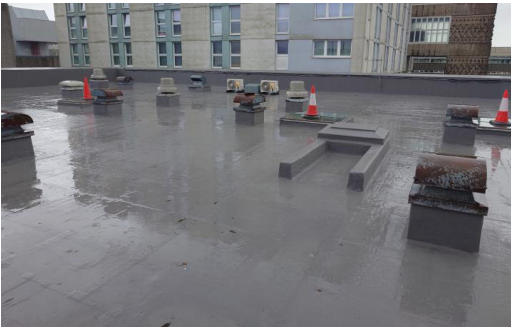
Most facilities managers learn about a roof problem from a stained ceiling tile or a bucket in a corridor. By then, the defect has usually been developing for months. The signs a commercial roof needs repair show up long before that, and you can spot nearly all of them without setting foot on the roof.
Check from inside, ground level, an overlooking window or drone imagery. HSE says treat every roof as fragile until a competent person confirms otherwise, so never walk an unassessed roof to check a sign, and be clear about who controls roof access.
The list covers felt, asphalt, single ply, liquid applied, metal and fibre cement roofs. Each sign ends with a call: Act now or Plan a repair.
1. Water Stains, Drips or Damp Ceilings Inside the Building
Not every stain under a flat roof is a roof leak. Treating it as one is how budgets get burned on patch after patch.
Look for stained ceiling tiles, drips at light fittings, tide marks at wall heads, and mould in ceiling voids. Water travels along decks and purlins, so the stain may be metres from the entry point.
If staining follows frost or cold, still spells rather than rain, or returns after the roof has been re-covered, suspect interstitial condensation. Typical causes are a missing vapour control layer, unsealed metal deck or composite panel laps, and unventilated cold-roof voids. As RIBAJ points out, another layer of membrane will not cure it.
Log each occurrence with date, weather and a photo. A surveyor can then confirm the cause with core samples and dew point analysis.
Act now if water is near electrics, stock or walkways. If staining follows cold rather than rain, ask for a condensation investigation before approving a patch.
2. Standing Water That Is Still There Days After Rain
The “48-hour” ponding rule on many roofing blogs is a US contractor rule of thumb. It is not in any UK standard.
The UK benchmark is BS 6229:2025, in effect since December 2025. It sets a minimum completed fall of 1:80 on most flat roofs and states backfalls are not acceptable under any circumstances. It also recognises short-term pooling at membrane laps, so a little water at a lap is not automatically a defect. Persistent flat roof ponding across the roof is.
IKO lists the usual causes: poor falls, deteriorating materials and insulation, uneven surfaces, and silt building up around outlets. Overflowing gutters and staining down the facade are ground-level clues.
Ponding adds dead load, stresses the waterproofing, grows moss and expands when it freezes. BS 6229:2025 now requires emergency overflows on single-outlet roofs.
Plan a repair for shallow ponding with clear outlets. Act now if water is deep, an outlet is blocked with no overflow, or ceilings below are deflecting.
3. Loose Flashings, Low Upstands and Lifting Roof Edges
Before worrying about the whole membrane, check the edges and junctions. Water usually gets in there first, and a localised repair often solves it.
From a window, ground level or drone imagery, look for:
- Flashings pulling away from walls
- Loose or missing edge trims, exposed to wind uplift
- Gaps around plant bases, pipes and rooflight kerbs
- Silicone smeared over joints as a “repair”
On one London survey, a roofer found 60 to 70 mm upstands where he expected 150 mm, with water running behind loose flashing. Building magazine adds plant dragged across roofs and cables nailed through waterproofing. e.surv calls these “detail failures”: localised repairs, not replacement.
Plan a repair in most cases. Act now if a trim or flashing is lifting, as it can detach in high winds.
4. Blisters, Crazing and Splits on Felt, Asphalt or Liquid Coatings
A single blister is easy to dismiss. A roof covered in them is a budget conversation to have early, not after a winter of leaks.
What membrane blistering tells you depends on the system:
- Felt and reinforced bitumen membrane: blisters from trapped moisture, crazing as UV takes out elasticity, cracks growing into splits, open laps and lost chippings.
- Mastic asphalt: UV crazing, splits, movement cracking and slumping at upstands (Building magazine).
- Liquid-applied coatings: manufacturer Rawlins Paints notes blisters at laps and gutters, delamination over damp substrates, and pinholes.
| What you see | What it usually means | Call |
|---|---|---|
| A few isolated blisters | Localised fault | Plan a repair |
| Crazing and splits across the field | Membrane near end of life | Repair or replace review |
If you see the second row, read our repair vs replacement guide before approving more patches.
5. Shrinking, Brittle Single Ply With Open Seams
A single ply roof can look clean and intact while slowly pulling itself apart at the edges.
On PVC, plasticisers migrate out over time. Technical literature, largely from outside the UK, describes aged membranes shrinking, turning brittle and stressing seams. In drone imagery or a contractor’s dated photos, look for:
- Membrane “bridging” or tenting at upstands and corners
- Taut membrane pulling at perimeter fixings
- Lifted welded seams
- Punctures around plant on any PVC, TPO or EPDM roof
If you see tenting at upstands, ask for a seam and perimeter check before winter.
Plan a repair. Act now only if a seam is open over an occupied area.
6. Rust Weeping From Laps on Metal Roofs and Cladding
Building magazine describes cut-edge corrosion on coated steel sheets as unavoidable in the long term once the zinc layer is used up. The question is when, not if.
From ground level or drone imagery, look for rust staining weeping from end laps and old repairs. Cladding refurbishment contractors also point to corrosion blistering of the coating just above the joint.
Check fixings too: corroded fasteners, perished washers, and sheets distorting around fixings from thermal movement. Clouded or discoloured rooflights matter as well, because HSE lists rooflights and corroded metal sheets as fragile surfaces. Underside condensation can also corrode sheets, showing as the drips in sign 1.
Plan a repair for early cut-edge corrosion: treat and seal it before it perforates. Act now where sheets are perforated, fixings have failed, or degraded rooflights sit where anyone may need access.
7. Cracked or Weathered Fibre Cement Sheets
Cracked sheets on an older warehouse can be a leak, fall risk and asbestos issue at once.
From inside or ground level only, look for cracked or slipped sheets, daylight through the roof, weathering and heavy moss.
HSE classes non-reinforced fibre cement sheets as fragile regardless of profile, and reports that falls through fragile surfaces, “particularly fibre-cement roofs and rooflights, account for 22% of all fall from height fatal injuries in the construction industry.”
On older buildings, assume asbestos cement until your asbestos register says otherwise. Regulation 4 of the Control of Asbestos Regulations requires the duty holder to monitor the condition of asbestos left in place, and weathering breaks down asbestos cement over time.
Act now. Check your asbestos register and restrict roof access before calling for a repair quote.
8. Damp, Soft or Cold Areas That Point to Wet Insulation
The hardest commercial roof damage to spot is soaked insulation under a membrane that still looks sound.
The signs are indirect. Contractors report spongy areas underfoot, ceilings stay damp or cold in patches, or leaks continue after a repair. Wet insulation also insulates worse, so heating costs can creep up.
Wet insulation releases heat more slowly after sunset, so thermal surveys usually run at night. UK drone providers combine optical and thermal imagery to map ponding, blocked outlets and probable wet areas without anyone on the roof. NSS offers drone surveys within its maintenance division.
Thermal shows probable wet areas, not proof. Confirm with cores or moisture probes to limit how much roof gets stripped.
Best for roofs with a leak history or a pending repair-or-replace decision. Plan a survey, then repair.
9. Patch on Patch: Repeated Repairs and Coated-Over Roofs
If the same roof section appears on your reactive maintenance log every autumn, the repairs are deferring a decision, not fixing the roof.
Look for patches of different ages, mastic over joints, and resin or paint over old membrane. One surveyor, on a coated house roof: “they’ve just put a resin coat over. You see the bumps? So, that will need replacing in the near future.” Repeated detail failures across a roof (sign 3) point to system failure.
Financial Ombudsman decisions show storm claims turning on whether the storm or gradual wear was the dominant cause. Inspection reports, photos and maintenance records are the evidence that settles it. Keep a dated log using our maintenance checklist.
Before winter, weigh one more patch against a condition survey and repair or replace review.
FAQ
Can I go up on the roof to check for these signs myself?
No. HSE says treat every roof as fragile until a competent person confirms otherwise, and rooflights can be hard to see or painted over. Check from below, then use a drone survey or a competent contractor with a safe system of work. Work at Height duties extend to anyone who controls the work, which can include you.
How often should a commercial flat roof be inspected?
At least annually and after severe weather. Building magazine notes that an annual inspection and clearing leaves from outlets prevents many flat roof failures. Spring and autumn suit UK leaf fall. Some commercial property policies carry flat roof inspection conditions, so check your schedule and endorsements.
Will my insurer pay for storm damage if the roof was already in poor condition?
It depends on the cause. Policies typically exclude wear and tear and gradual deterioration but cover damage from an insured peril such as a storm. Disputes turn on whether the storm or the roof’s condition caused the loss, so dated inspection reports, photos and repair records are your evidence.
Should I repair or replace a commercial roof?
Repair isolated detail failures, such as a lifting flashing or split lap. Widespread crazing, repeated leaks in different places or saturated insulation point to system failure, where replacement or overlay is usually better. See our repair vs replacement guide.
Not sure which sign you are looking at? Talk to NSS. Our directly employed roofing teams work nationwide and can start with a drone survey, so nobody steps onto an unassessed roof.